In late 2025, Bulgaria introduced one of Europe's most practical remote work visas. For non-EU freelancers and remote employees earning over €31,000 a year, it opens the door to two years of legal residence inside Schengen — at a flat 10% tax rate, at 30% below EU average cost of living.
Important distinction: There is no standalone "Digital Nomad Visa". The correct name is a long-term residence permit for digital nomads, based on amendments to the Law on Foreigners in Bulgaria effective December 2025. The process is two-stage: Type D visa at a Bulgarian embassy → residence permit in Bulgaria.
Who Can Apply
Non-EU/EEA/Swiss citizens in one of three categories:
- Remote employees — working for a company registered outside Bulgaria, the EU, EEA, and Switzerland, providing services exclusively from abroad
- Freelancers and independent contractors — with at least 1 year of documented remote work for non-Bulgarian clients (contracts, invoices, or platform earnings)
- Business owners — holding at least 25% of a company registered outside Bulgaria that serves no Bulgarian-resident clients
European clients are fine — with one asymmetry worth knowing. For freelancers and business owners, the rule is simply "not Bulgarian": a German, French, or any other EU-based client or company is completely fine, individuals and companies alike.
Remote employees are the exception — that category specifically requires your employer to be registered outside Bulgaria, the EU, EEA, and Switzerland, so an EU-based employer doesn't qualify you under this route even though an EU-based client would for a freelancer. If you're an employee of an EU company, the freelancer/contractor category or the standard work permit route are worth checking instead.
EU/EEA citizens don't need this visa at all — you can move to Bulgaria on freedom-of-movement rights alone, with no income threshold and no application process.
Once you've registered a Bulgarian address, the equivalent way to freelance legally is registering as свободна професия (liberal profession / freelancer status) — genuinely simpler than both this visa and full company registration. Registration (BULSTAT + a self-insured status with the NRA) typically takes about a day, and freelance income gets the same automatic 25% expense deduction described below, working out to roughly a 7.5% effective tax rate — among the lowest for freelancers anywhere in the EU. It only makes sense to switch to a company (EOOD) once your income grows into a range where the company's fixed social-insurance base becomes cheaper than a freelancer's — usually somewhere above €60,000–€65,000/year, though the exact crossover depends on your numbers. See our company registration guide for that comparison in detail.
Income Requirement
You must demonstrate an average monthly income of at least 50× Bulgaria's minimum monthly salary over the previous 12 months. At 2025–2026 rates, this works out to approximately €2,580–€2,700/month gross (€31,000–€32,400/year). Verified through employment contracts, invoices, bank statements, or platform earnings.
How the 10% Flat Tax Actually Works
Bulgaria taxes personal income at a flat 10% — but the permit itself doesn't automatically make you a Bulgarian taxpayer. Tax residency is a separate, days-based test, and it catches a lot of nomads off guard.
Under 183 days in Bulgaria: Bulgaria doesn't count you as a tax resident, so it can only tax money earned from Bulgaria. Since your clients or employer are abroad, there's usually nothing for Bulgaria to tax — most nomads who split their year across a few countries end up owing Bulgaria €0 in income tax.
183+ days (or Bulgaria is genuinely the centre of your life): you become a full Bulgarian tax resident, and everything you earn anywhere in the world — salary, freelance income, dividends, capital gains — gets taxed here at 10%. Freelancers get a built-in discount: the tax office automatically treats 25% of your income as business expenses, whether it was or not, so you're only taxed on the remaining 75%. Do the math and that comes to about 7.5% of your total income — not the full 10%.
Bulgaria has double taxation treaties with more than 70 countries — including the US, UK, Germany, France, and the Netherlands — designed to stop the same income being taxed twice. But a treaty doesn't apply itself: you generally need to actively de-register from your previous country's tax residency to benefit, which is worth sorting out with a tax advisor before you move, not after. Ask us about your specific situation.
Reducing Your Tax Bill Once You're a Resident
If you cross the 183-day line, the single biggest lever is already built into the tax code — but only if your income gets declared correctly.
- Declare freelance income as freelance income. The 25% expense deduction applies to income classified as freelance or personal-services earnings on your annual return — not to income lumped in as generic "other income." Getting this classification right on your filing (Form GDD-50, due 30 April) is what actually gets you from 10% down to the ~7.5% effective rate, with no receipts required.
- File every year, even if tax was already withheld abroad. Bulgaria still requires you to declare worldwide income as a resident; the treaty then offsets what you've already paid elsewhere rather than exempting you from filing in the first place. Skipping the filing because "it was already taxed abroad" is a common and costly mistake.
- Keep proof of de-registration from your previous country. Treaty relief depends on it, and it's far easier to gather this paperwork before you leave than to chase it down later from abroad.
One genuinely gray area: whether to formally register as свободна професия purely for tax-reporting purposes while still on this visa. It can make claiming the deduction cleaner and build proper Bulgarian social security credit, but it sits close to the line of what the permit's rules mean in practice — this is a real conversation for an accountant familiar with both the visa and the tax code, not a DIY decision.
Every situation here depends on details specific to you — prior country, income mix, how long you plan to stay — so none of this is a substitute for a proper plan. Ask us to connect you with an accountant who can plan your tax properly.
What the Permit Does NOT Allow
You cannot work for Bulgarian clients or companies registered in Bulgaria
You cannot invoice Bulgarian-resident clients at the time of the transaction
You cannot be employed by a Bulgarian-registered company
The permit does not lead to permanent residency — after 2 years you must transition to a different category (company registration, TRO, or financially independent person)
To be clear, none of this applies to clients or employers based anywhere else — a client in Germany, France, or the rest of the EU is exactly as fine as one in the US or Australia. It's specifically Bulgaria-based business that's off-limits.
The Two-Stage Application Process
Type D visa at the Bulgarian embassy
Apply at the Bulgarian embassy or consulate in your country of residence. Indicate "digital nomad residence permit" as the basis. Provide proof of remote income for the past 12 months. This visa permits entry into Bulgaria to apply for the permit itself.
Residence permit at the Migration Directorate
Within the validity of your D visa, submit your application at the Bulgarian Migration Directorate. You will need your lease, health insurance, bank statements, and employment/client documentation. You receive a biometric plastic card valid for 1 year.
Renewal (optional)
Apply for a 1-year renewal at least 2 months before expiry. Same income verification required. After 2 years on this permit you must switch to another residency basis — the most natural next step is opening a Bulgarian company (EOOD).
Required Documents
- Passport valid for at least 18 months beyond the visa period
- Type D visa (issued at the Bulgarian embassy)
- Proof of remote employment or freelance income for 12 months (contracts, invoices, bank statements, platform screenshots — all translated and certified in Bulgarian)
- Health insurance valid in Bulgaria — minimum €30,000 coverage
- Lease agreement or proof of property ownership in Bulgaria
- No criminal record certificate with apostille
Ask us to help you figure out which stage you're at and what to prepare next.
Best Cities for Digital Nomads
The permit doesn't tie you to a specific city — where you actually base yourself makes a real difference to cost and daily life.
| Monthly cost | Sofia | Plovdiv | Varna | Burgas / Sunny Beach |
|---|---|---|---|---|
| 1-bed rent | €600–€700 | €320–€450 | €380–€520 | €400–€460 |
| Coworking desk | €85–€180 | €60–€100 | Cafés & coliving | Cafés & coliving |
Sofia is the obvious first stop for most nomads — it's where the community, coworking spaces, and English-speaking services are most established. Plovdiv is the budget-conscious alternative with genuine culture and a 2.5-hour drive to Sofia's airport. The coast suits anyone prioritising lifestyle over networking: Varna has its own international airport and more city infrastructure, while Burgas also has its own airport and leans slower-paced and beach-focused, especially around Sunny Beach outside peak summer. For a deeper comparison of all four (plus smaller towns), see our Where to Live in Bulgaria guide.
Bulgaria vs. Other Digital Nomad Visas
Bulgaria's visa is genuinely competitive — mainly because the income bar is so much lower than most alternatives.
| Bulgaria | Spain | Croatia | Portugal | Estonia | |
|---|---|---|---|---|---|
| Min. income | ~€31k/yr | ~€34k/yr | ~€44k/yr | ~€44k/yr | ~€54k/yr |
| Tax rate | 10% flat | 24% flat | 0% foreign | Standard | 22% flat |
| Duration | 1 yr +1 | Up to 5 yr | Up to 18 mo | 1–2 yr | 1 yr |
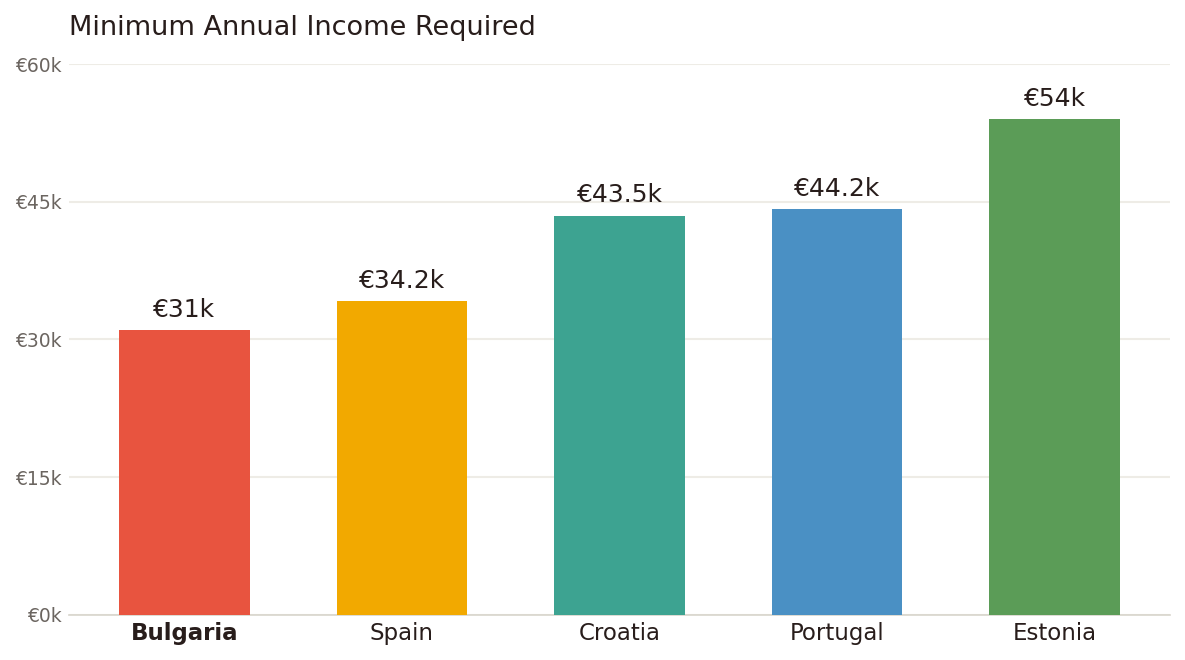
Bulgaria wins outright on income threshold — roughly 30% lower than Spain, 40% lower than Croatia and Portugal, and nearly half of Estonia's. Spain's 24% flat rate also comes with a catch worth flagging: it only applies under the Beckham Law special regime, and only to employees — freelancers don't qualify and fall back to Spain's standard progressive rates, up to 47%. Croatia's 0% tax is attractive on paper, but the visa can't be renewed in-country and the income bar is much higher. Portugal offers the clearest long-term path to residency, but at a significantly higher income requirement and with standard IRS progressive rates once you're resident — nine brackets running from 12.5% up to 48%, with the top rate kicking in above roughly €81,000/year. Portugal's old NHR regime (a flat 20%) ended in 2024; its replacement, IFICI, is far stricter, and most digital nomads and freelancers won't qualify. For someone who qualifies for more than one of these, the honest trade-off is: Bulgaria for accessibility and low tax now, Portugal for the long game toward EU citizenship, Croatia if you can clear the bar and want zero tax for a defined stint.
Digital Nomad Visa vs. Company Registration vs. Trade Representative Office (TRO) — Which Is Right for You?
| Digital Nomad Visa | Company (EOOD) | TRO | |
|---|---|---|---|
| Best for | Remote employees & freelancers | Business owners, consultants | Employees of foreign companies |
| Local clients? | No | Yes | No |
| Leads to residency? | No (2-yr max) | Yes (5 yr) | Yes (5 yr) |
Our honest take: The Digital Nomad Visa is genuinely excellent for a first 1–2 years in Bulgaria. But if you plan to stay long-term, registering a company is ultimately more flexible, cheaper per year, and the only path to permanent residency.
Common Mistakes
Assuming you can pick up Bulgarian clients on the side. You legally can't — even one local invoice puts the whole permit at risk.
Not having a full 12 months of documented income ready. Gaps or undocumented months are one of the most common reasons applications stall.
Treating the visa as automatically tax-free. It isn't — spend 183+ days in Bulgaria and your worldwide income becomes taxable here at 10%, whether you planned for it or not.
Underestimating certified-translation costs. Every foreign document — contracts, bank statements, criminal record — needs a certified Bulgarian translation, which adds up fast if you leave it to the last minute.
Setting Up Once You Arrive
The visa gets you in the door — a few practical steps make the rest of the move actually work:
- Banking — opening a Bulgarian account as a nomad-visa holder is possible but more paperwork-heavy than for company owners; see our Banking in Bulgaria for Foreigners guide for what's different about opening one on this specific permit.
- Healthcare — the €30,000 private insurance covers your visa requirement, but most nomads add a cheaper local top-up once settled; see our Healthcare in Bulgaria for Expats guide for real hospital contacts by city.
- Cost of living — budget realistically before you commit to a lease; our Cost of Living in Bulgaria guide breaks down rent, groceries, and everyday costs city by city.
- Filing with the NRA — if you register as a freelancer (свободна професия), most declarations and NRA correspondence go through Bulgaria's e-government portal, which requires a QES (Qualified Electronic Signature, known locally as a KEP). See our QES in Bulgaria guide.
How We Can Help
Everything on this page is meant to get you oriented, not to replace the actual work of putting an application together. That part is where we come in. We help people through the whole arc of this — working out which of the three eligibility categories genuinely fits before you spend money on translations, assembling and checking the income documentation that Bulgarian consulates actually want to see, and walking you through both stages of the process so nothing stalls on a technicality. Once you're here, we can also point you toward the right people for the parts that need a specialist — an accountant for the tax side, a bank that's genuinely used to nomad-visa applicants, a landlord who won't disappear when you need a lease for your permit. Ask us to help you settle or prepare for this move.
Want the checklist, process timeline, and country comparison on hand even offline? Get the full guide as a free PDF — no email needed.
Download